Once an agent has built a 3D scene, I need a way to turn review findings into a useful next request. A broken material assignment needs a repair. A requirement I forgot to put in the brief needs a decision from me. Sending both back as “the scene failed” leaves the agent to guess what should change.
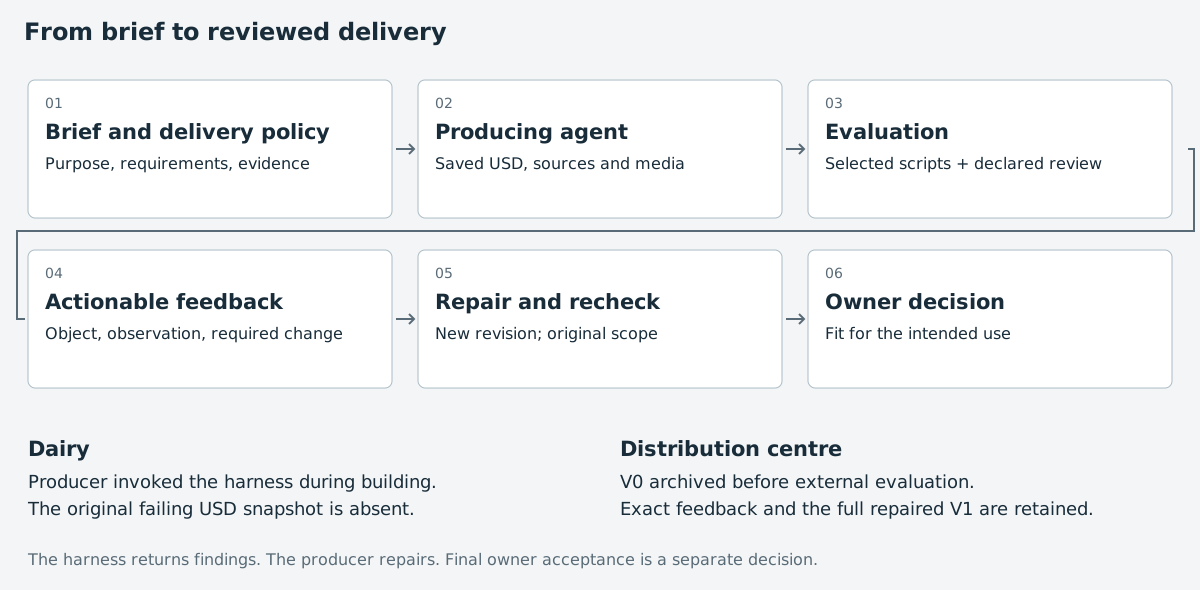
I followed two agent-built scenes through that process: a dairy layout for visualization and a larger distribution centre with moving parcels, a shuttle and a gate. The Scene Acceptance harness runs selected checks on a saved scene and reports the findings. The agent changes the scene; I still have to decide whether the requirements and evidence are enough for its intended use.
The dairy showed the straightforward case: a validator found broken material bindings and the producing agent repaired them. The distribution centre exposed two different problems. Its automated rejection came from a delivery policy the brief never stated, while separate review found a route indicator showing the wrong state between events that passed their checks. Following the feedback through to a repaired delivery helped me distinguish a better brief from a better scene.
The harness checks and reports, the producing agent changes the scene, and the owner decides whether the declared use is satisfied. The two runs differ in when the harness ran.
Two briefs, with different demands
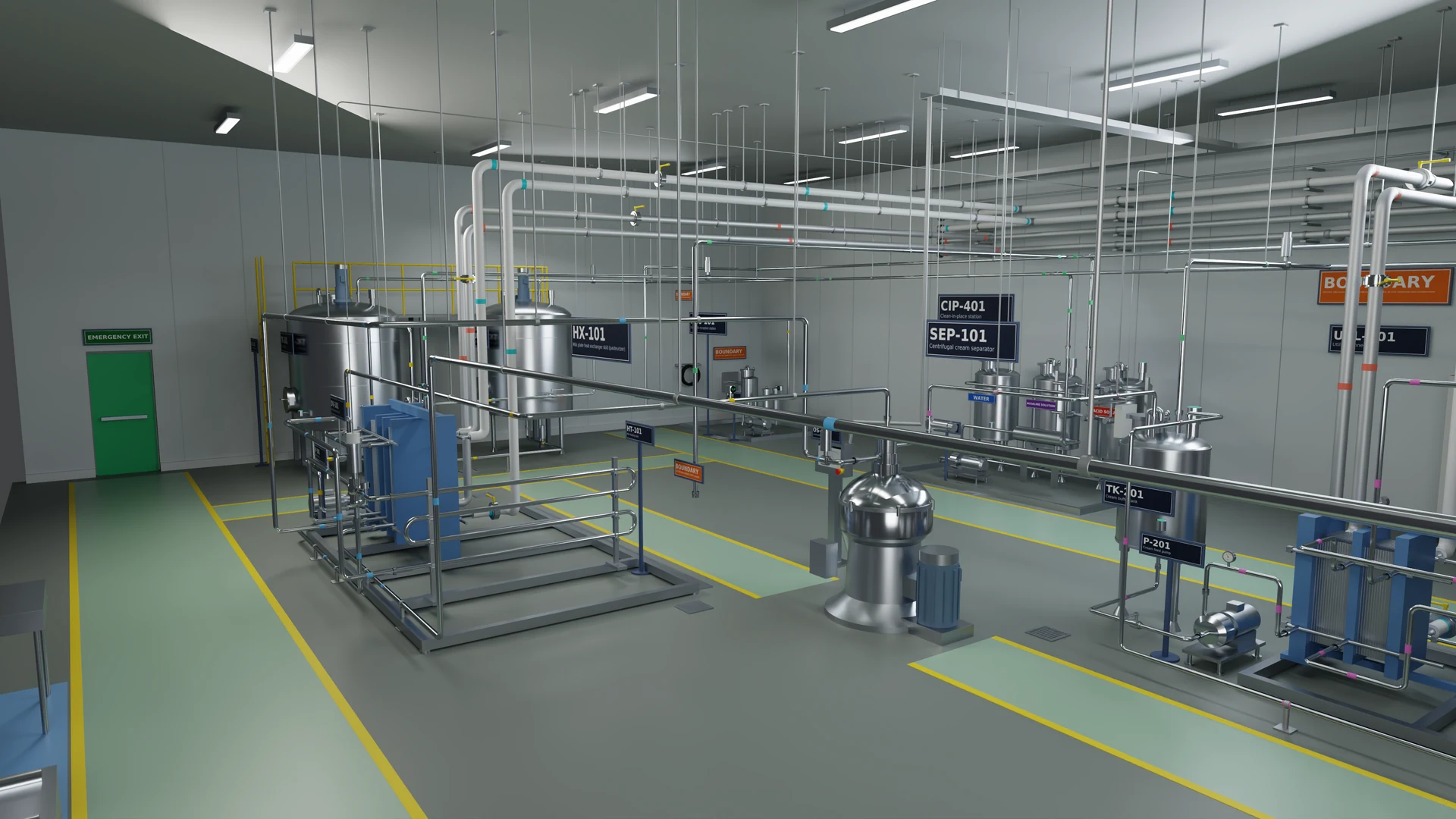
The issued dairy brief describes a conceptual 24 × 16 m hall for milk reception, separation, treatment, storage and cleaning. I chose realistic visualization as its purpose, and an assistant helped specify the equipment and acceptance questions. Its 5,000 litres/hour capacity is illustrative, not a validated dairy design.
The dairy delivery, rendered with NVIDIA RTX. This view adds a presentation camera, lighting and stainless finishes over the delivered geometry, so it says nothing about the original producer’s material appearance.
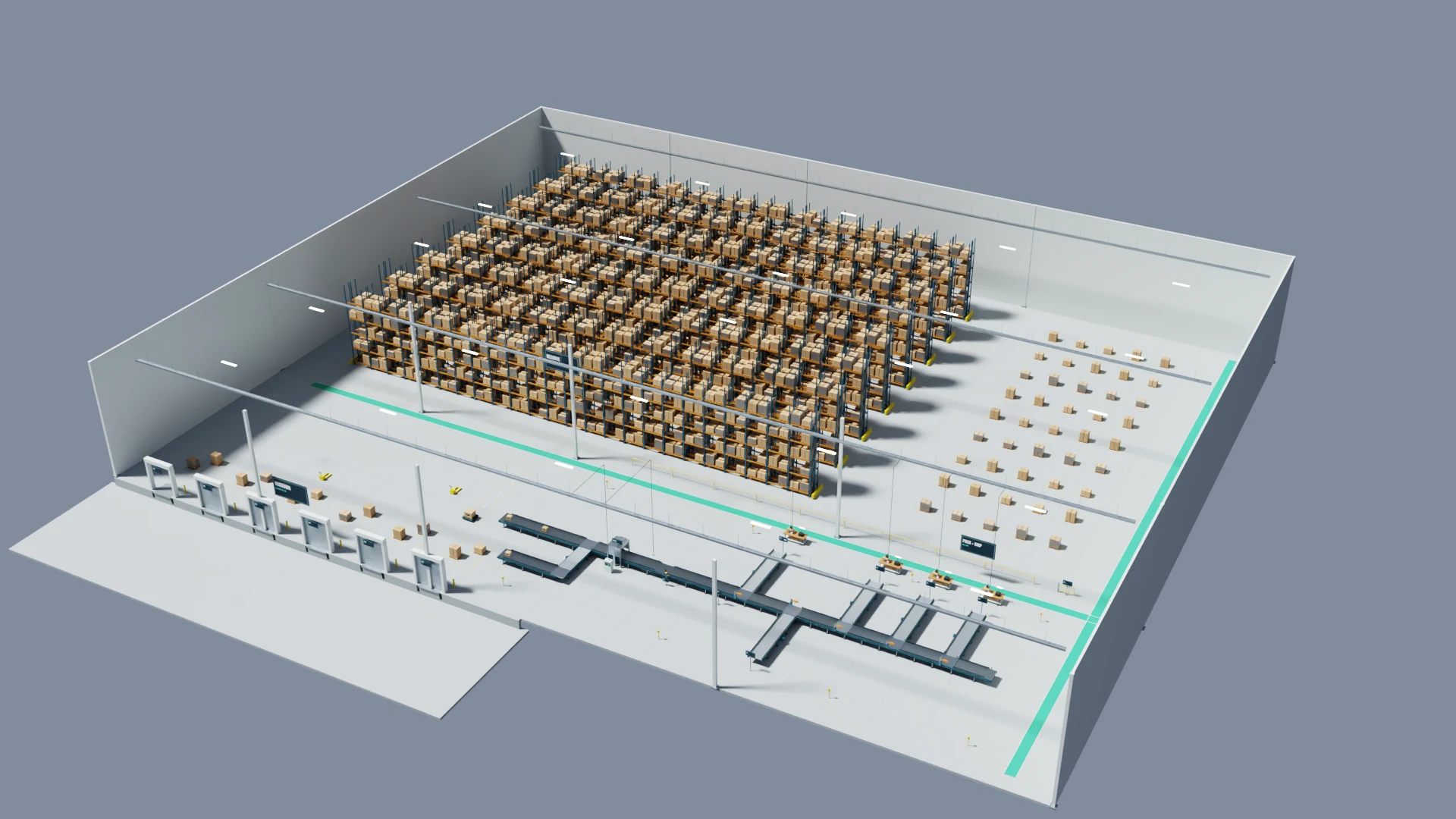
For the second assignment, I wanted a larger scene with motion and explicit texture requirements. A prim is any scene element, visible or not. The second brief asks for a fictional 120 × 96 m distribution centre with six docks, 3,840 rack positions and more than 100,000 useful composed prims. Its 30-second sequence gives three parcels named scan and destination times and routes them past diverters to outbound lanes or a reject lane. It also stops one of them from 12 to 15 seconds, carries an attached pallet on a shuttle, swings a gate and switches lamps amber → red → green. Two supplied PNGs must keep their pixels, size and orientation. The animation is kinematic; contact simulation is outside the brief.
The repaired distribution-centre delivery, rendered directly from its saved USD with NVIDIA RTX, with source geometry and materials unchanged.Compare the size and contents of the two deliveries
Scroll sideways for more columns.
Saved-scene complexity
Dairy delivery
Distribution centre, first → repaired
Composed prims
2,081
125,206 → 125,224
Meshes
1,105
121,602 → 121,615
Mesh vertices
244,556
1,018,996 → 1,019,222
Polygon faces
162,782
750,636 → 750,772
Materials / texture images
158 / 99
47 / 25 → 48 / 26
File-backed USD layers
7
16
Authored operation
Static scene
Parcels, shuttle, gate and lamps
The dairy: a concrete defect with a local repair
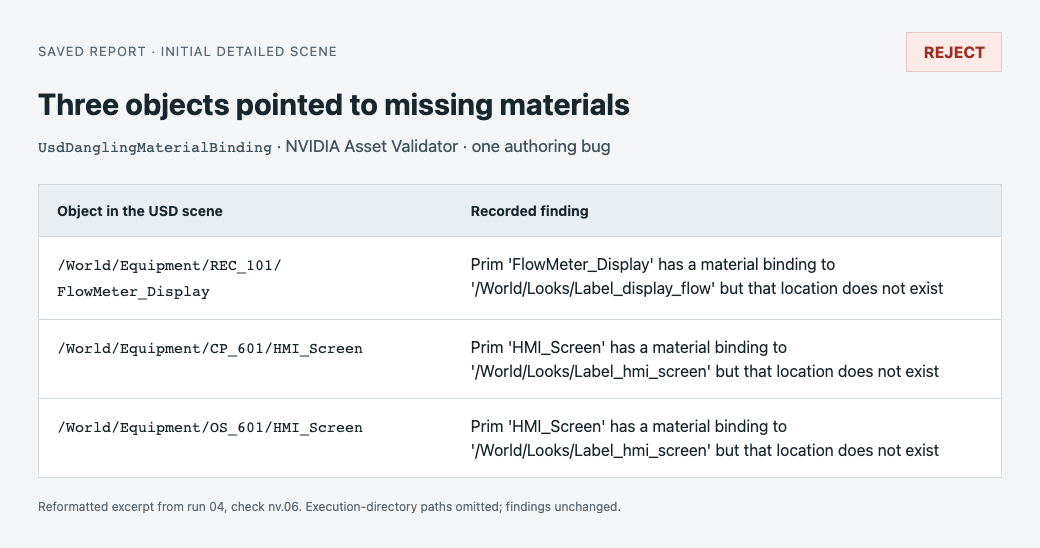
The dairy producer used harness release 0.5.0 during its build. At the first detailed revision, NVIDIA’s UsdDanglingMaterialBinding validator rule returned failures for a flow-meter display and two HMI (human-machine interface) screens; their assigned material paths did not exist.
The saved JSON findings, reformatted for readability. This is one authoring bug affecting three objects. The underlying NVIDIA validator supplies the diagnostic.
The agent registered the display textures in its generator, regenerated the scene and reran the checks; the binding rule passed and the baseline of general checks returned ACCEPT_FOR_USE for its selected scope. The failing USD was not preserved, so the report and repair log are what survives of that revision. The visual requirements and the agent’s proposed tolerances stayed open.
The producer also planted fourteen faults in copies of the finished scene: general checks rejected two, and adding task-specific measurements raised the total to seven. The other seven were not rejected by the selected scripts and remained under review; a blocked aisle was among them. I would use controls like that to find gaps in the checks, and keep them apart from failures in the delivery.
The larger trial: preserve the delivery before evaluating it
For the distribution centre, the producer received only the neutral assignment packet in a fresh project. The coordinator who wrote the brief prepared the checks before the first delivery arrived. That package (V0) was archived before any findings went back, and the evaluation scope stayed unchanged through the repair.
The released harness stopped at 10,000 prims, so the trial used a 0.5.1 development build that took caller-selected limits and reported insufficient evidence above them. Its brief-derived checks ran from a trial-owned check pack, a group of checks written for this trial. A synthetic 150,000-prim control still found a dangling binding placed on its last mesh, a test that large inputs were not being truncated. The trial records give the code version, controls and limits.
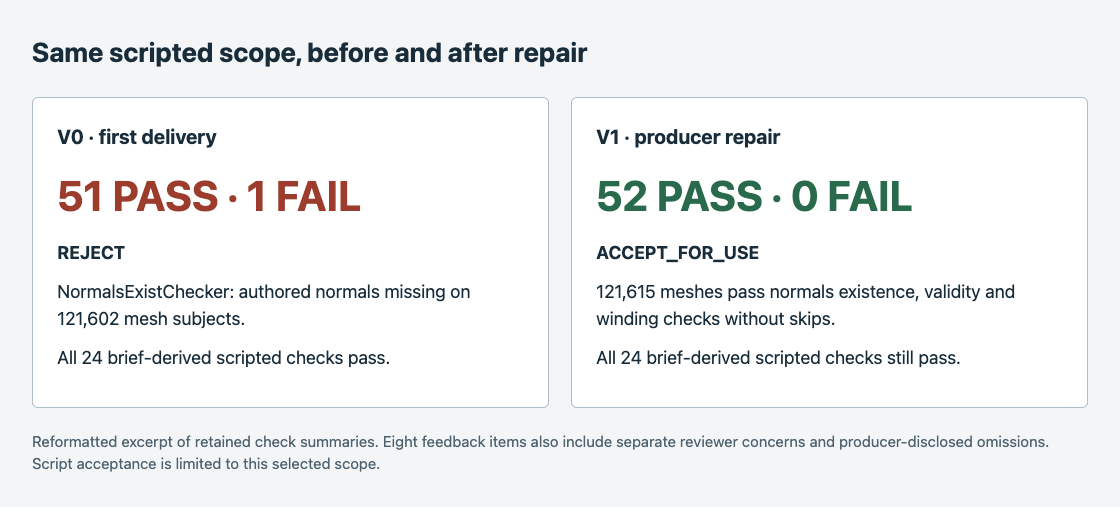
V0 returned 51 PASS and one FAIL across 52 rows. All 24 brief-derived scripted checks passed, including parcel event timing, the stop, attachment, gate/lamp schedules, reference textures and selected material values. The other 28 rows were general checks, among them the OpenUSD and NVIDIA Asset Validator rules. The failing row was NVIDIA’s NormalsExistChecker: all 121,602 mesh subjects lacked authored normals under the selected polygon-delivery policy.
The brief had not asked for authored normals. It was one policy applied to 121,602 meshes. Missing normals did not by themselves show that the scene was invalid for this visualization task. I needed to decide whether the receiving application required them. The downstream normal-validity checks had skipped those subjects, so their aggregate PASS offered no evidence about normals either.
Excerpt of the retained results. The repair changes one scripted row from FAIL to PASS. Separate review supplied the other observations.
A parcel can arrive on time while its route indicator is wrong
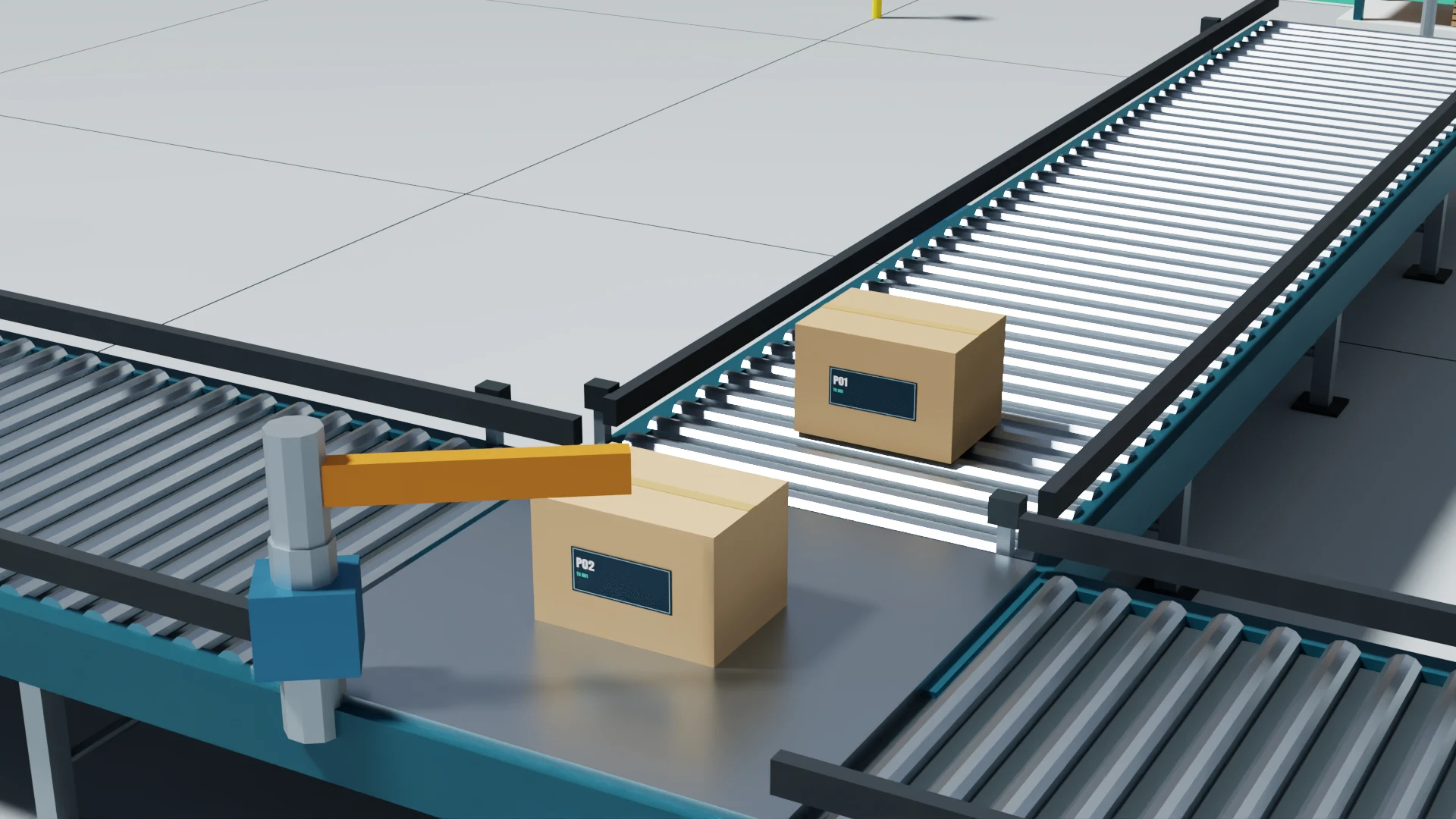
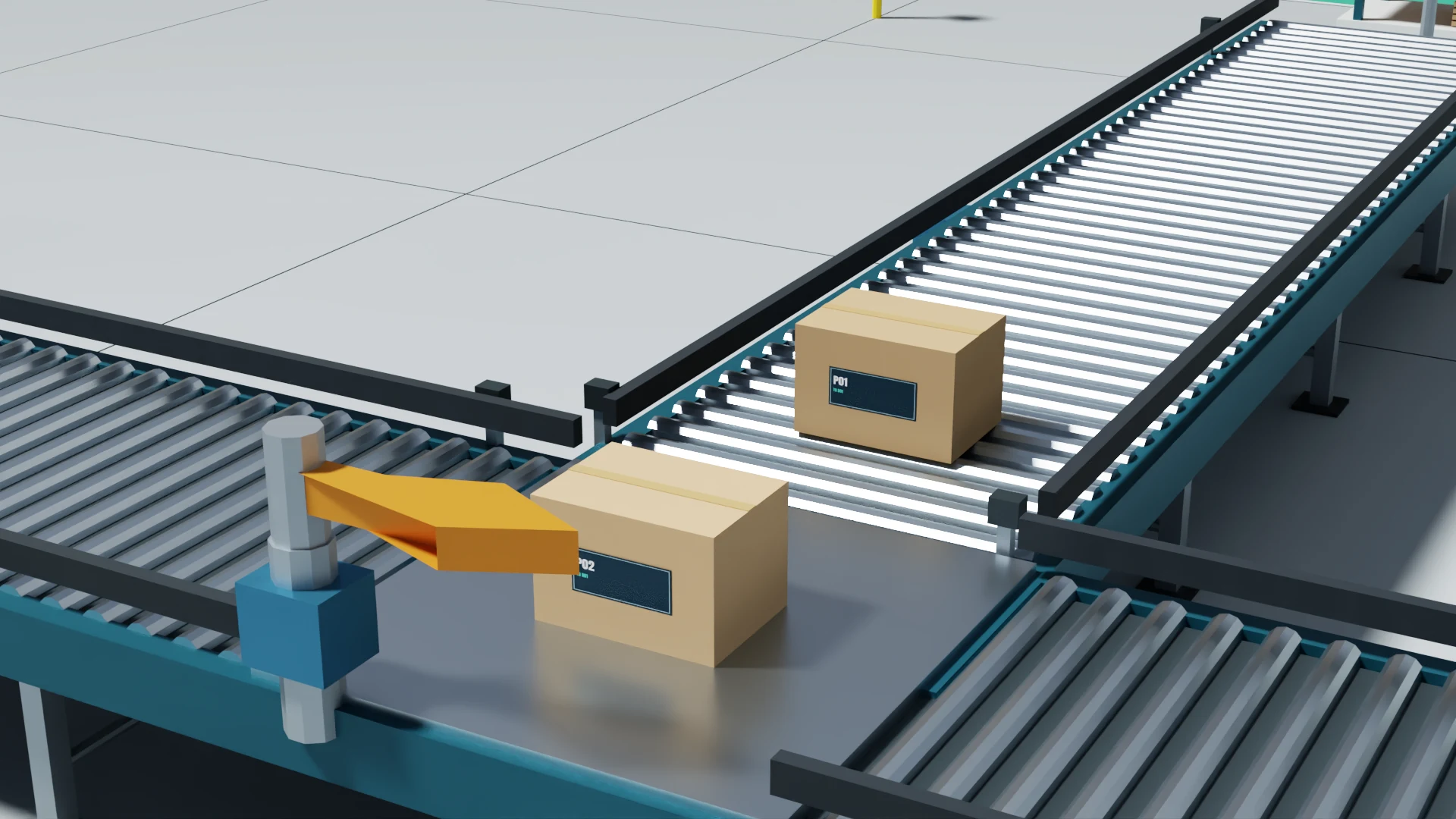
In this scene, diverters at the sorting junctions act as route indicators, showing which branch each passing parcel takes: an outbound lane such as D01, or the reject lane. Parcel P02 reached reject lane R01 at 19.999 seconds, within the requested tolerance. But while it passed the first junction from about 14.755 to 15.791 seconds, DIV01, the diverter there, still showed the branch for P01, a parcel bound for D01. The endpoint and timing checks passed; they did not test that indicator’s meaning through every traversal.
A separate geometry-review agent found the mismatch. The producer had described the raised vanes as non-contact indicators, so the repair only had to make the displayed route agree with the parcel’s path.
That simplification fits an explanation of parcel flow: the indicator shows the route without physically pushing the parcel. Its direction still matters, because a viewer following it would otherwise be shown a different route from the parcel’s actual path. A study of physical diversion would need a suitable contact model and additional evidence. Declaring the non-contact choice let me judge it against this scene’s purpose.
Before: the vane remains selected toward D01.
After: the arrow indicates straight for P02.
Native RTX views at the same camera and 15.273-second timestamp. V1 changes both the indicator shape and its schedule. Screen overlap is not a clearance measurement.
The indicator and the normals failure went back to the producer in the same redacted feedback. It contained eight items, grouped below by the repair they requested, with the automated condition kept apart from review concerns. The producer’s response records how it addressed each one.
Scroll sideways for more columns.
Finding returned
Producer’s change
Separate recheck
Missing authored normals under the chosen policy
Authored normals and updated the generator
All 121,615 repaired-scene meshes pass existence, validity and winding checks without skips
Indicator state and unclear non-contact role
Retimed indicators, made arrow shapes and added a mounted explanatory sign
Correct states throughout all six reviewed parcel/junction traversal intervals
Services below the brief’s 14 m clear-height target
Raised overhead services and roof structure
All 209 checked overhead meshes clear 14 m; lowest underside is 14.060 m
Tray-obscured view and floating gate sign
Reframed the camera and added sign supports
Native stills corroborate the changes; separate measurements check the selected gate sweep
Disclosed lamp-hardware and GUI-evidence omissions; unreadable wide sequence
Completed mounting and supplied detail views, explanations and application captures
Visual/source review supports the repairs and records the performance limits
The original producer returned a complete repaired package, V1. The unchanged scripted scope passed 52/52 rows, with no regression among the 51 previously passing rows. Evaluation took about 75 seconds and 1.71 GB peak process memory on the recorded host.
Show the delivered 30-second explanation videoHide the explanation videoThe producer’s explanation video combines views of the reopened USD with a labeled diagram and measured states, so IDs and scan events stay readable where the scanner shell hides a parcel. Review checked all 721 supplied state rows against USD readback.
Write the delivery policy into the brief. The dairy bindings were broken whatever the brief said; the normals failure only happened because nobody had told the builder about the rule. Keeping those two apart in the report gives the builder a repair request it can understand, and it gives me a better next brief, because an unstated rule left out again would come back as the same failure on the next delivery.
Check the operation between named events. None of the 24 scripted requirements tested what the indicator meant during each traversal, and DIV01 was wrong for about a second between two timed events that both passed. The gate, the payload attachment and the stop interval gave the scripts useful intermediate requirements. For the diverter’s meaning I would name a review step in the brief; here it took a review agent working outside the harness’s optional judge path (its model-based review of supplied views). The brief already required the diverter to hold the correct route until the parcel cleared. The repair addressed a missed requirement; the review exposed a gap in the selected checks.
Make the repair observable. The missing dairy snapshot limits replay. For the distribution centre, the first package, the exact feedback, the producer’s response and the revised package all survive. The same contract, the file of targets and tolerances the checks read, can be rerun, and matched views show what changed. That record is more useful to me than asking the builder whether it fixed everything. The evidence collection and the published evidence subset support the findings; the trial’s runtime, custom pack and full deliveries are not in the public repository, so neither replays a whole build.
Keep usability in the acceptance decision. Passing every scripted row still left a serious usability concern. The producer recorded about 4.5 viewport draw callbacks per second while orbiting the scene imported into Blender, in solid view, and 2.63 per second over a short playback sample of frames 0–47. Those numbers were checked against the producer’s logs but not rerun. The brief set no minimum frame rate. For a scene someone has to navigate, I would state the target application, machine and required performance.
The validators supplied structural findings; the harness kept the selected checks and measurements together, while the caller supplied review and repair coordination. From two builds I can’t tell whether running the harness this way beat a validator plus a careful reviewer. The coordinator had seen some draft code, so the test was not blinded. The builds used different agents and tools. Physical operation and final owner acceptance remain unverified; the coverage record names the packs, subjects and limits.
Later package capabilities and compatibility
Release 0.6.0 has a fixed limit of 10,000 prims. The development package, an unreleased 0.7 snapshot, lets callers raise that budget, compare a saved state attribute with a declared timeline, and record viewer frame times that the caller measures. To test DIV01 this way, the owner would need to put the expected indicator schedule in the reviewed contract, and the scene would need an attribute that faithfully represents the displayed state. The check cannot infer that state from meshes or rendered views. I have not rerun any of these checks on this distribution centre. An experimental audit can also ask about omitted requirements; its questions still need review. The extensions guide and the state-timeline notes explain how to select those checks.